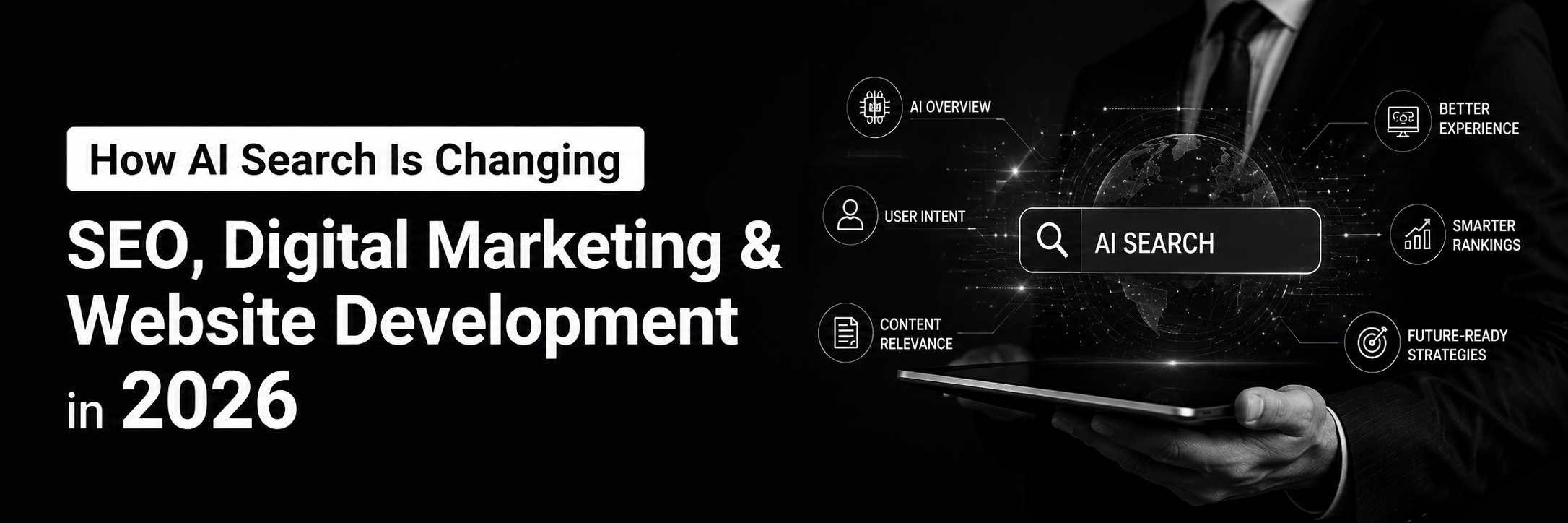
There have been substantial shifts in how people use the Internet to search in the last few years. By 2026, “AI-generated” search results won’t just show a list of blue links—they’ll be providing direct answers, summarizing content, comparing products and other features, and assisting in user decision-making with only a single click.
This shift is changing the way businesses approach SEO, content development, user experience, and online visibility and presence. Brands that have long relied on traditional search results are now evolving to meet the needs of a customer base increasingly using AI-powered search assistants, conversational search, and answer engines for discovery.
With the continuous advancement of AI search, enterprises need to revisit their website development and Digital Marketing strategies to stay competitive. For businesses seeking to remain visible, draw in targeted visitors, and provide outstanding user experiences, comprehension of these transformations is pivotal.
Search engines have evolved from simple keyword-matching systems into sophisticated AI-driven platforms capable of understanding context, intent, and natural language.
Users today ask complete questions rather than typing short keyword phrases. For example, instead of searching for “best CRM software,” they might ask:
“Which CRM software is best for a growing B2B company with a remote sales team?”
AI search engines analyze the query, evaluate multiple sources, and provide a comprehensive answer instantly.
This shift means businesses can no longer focus solely on ranking for keywords. Instead, they need to create authoritative, trustworthy, and user-focused content that AI systems can confidently reference.
The goal is no longer just to appear in search results—it is to become part of the answer.
SEO in 2026 looks a lot different from what it did just a few years ago for marketers and businesses. The rise of AI-powered search engines has transformed the search process, how information is evaluated, and how it is delivered to users. Modern search systems understand context, intent, user behavior, and semantic relationships between topics — not just matching keywords to web pages.
Traditional ranking factors such as backlinks, keyword optimization, website speed, and technical SEO still count. But they are now integrated into a far more extensive ecosystem that values content quality, relevance, expertise, and user satisfaction above all else.
Businesses that continue to rely solely on old SEO tactics may find themselves losing visibility, while brands that create valuable, trustworthy, and comprehensive content are gaining greater exposure through AI-generated search experiences.
One of the biggest changes brought by AI search is its ability to understand user intent with remarkable accuracy.
In the past, SEO strategies were often focused on finding exact match keywords and stuffing them all over a web page. Keywords still matter, but today’s AI search engines are less about keywords and more about understanding what the user really wants to do.
For example, if someone searches for “best project management software for remote teams,” AI systems can determine that the user is likely looking for comparisons, features, pricing information, and recommendations rather than a simple definition of project management software.
This means businesses must create content that:
AI-generated search results are more likely to quote, summarize, and recommend content that will help users achieve their goals.
Furthermore, businesses should work on producing content for all stages of the customer journey, including awareness, consideration, decision, and retention. AI systems are now more and more judging how well content serves a user’s intent, not how many times a keyword appears on a page.
AI search engines are increasingly favoring sites that show a deep expertise in a particular subject area.
Instead of ranking individual pages in isolation, AI systems judge the knowledge and authority of an entire site on a given topic. A website that regularly has good content on a particular niche is more likely to be recognized as a trusted source.
For example, a technology company that regularly publishes in-depth articles about cybersecurity, cloud computing, software development, artificial intelligence, and digital transformation is more likely to establish topical authority than a website covering unrelated subjects.
Building topical authority requires:
Businesses should view their websites as knowledge hubs, not just a collection of disconnected blog posts. All content should be part of a larger content ecosystem around a topic to establish expertise and authority.
As AI search continues to evolve, websites with strong topical authority are increasingly being featured in AI-generated summaries, answer boxes, and conversational search results.
Experience, Expertise, Authoritativeness, and Trustworthiness (E-E-A-T) remain central to search visibility in 2026.
Since AI search engines are responsible for generating direct answers to user questions, they must rely on information from trustworthy and credible sources. As a result, websites that demonstrate strong E-E-A-T signals have a significant advantage.
To strengthen trust and authority, businesses should:
Experience has taken on special importance. Search engines are rewarding content created by people with real-world expertise and first-hand knowledge more and more. In fact, case studies, personal experiences, success stories, and practical examples tend to outperform generic AI-generated content.
Today, trust has become one of the most valuable assets in SEO. As misinformation continues to proliferate online, AI search engines are more committed than ever to finding and surfacing trustworthy sources.
The rise of AI search is forcing marketers to rethink how they attract, engage, and convert audiences.
For many years, many businesses focused primarily on driving traffic to their websites through organic search rankings. But now, users are getting answers right in the AI-powered search interfaces, so fewer clicks are going to traditional websites.
This means Digital Marketing strategies are moving from being traffic-focused to being authority-focused and brand-focused.
Content remains one of the most powerful tools in modern marketing, but its role has evolved significantly.
Instead of creating content solely to rank for search terms, marketers must develop resources that establish expertise, educate audiences, and support decision-making.
Effective content now focuses on:
The quality of content matters more than the quantity. A comprehensive guide that thoroughly addresses a user’s needs often delivers better results than dozens of short, keyword-focused articles.
High-value content also increases the likelihood of being referenced by AI systems when generating responses.
In the era of AI search, brand recognition is becoming increasingly important.
When responding to users’ questions, AI-produced answers often name specific brands, groups, and specialists. This means businesses with good reputations benefit even if users never visit their websites directly.
Modern Digital Marketing efforts should focus on:
A recognizable and trusted brand is more likely to be referenced by AI systems than an unknown competitor with similar content.
Search engines are no longer the only path to discovering brands and products.
Today’s consumers interact with businesses across multiple channels, including:
As search technology evolves, a diversified marketing strategy helps businesses remain visible.
Successful Digital Marketing campaigns by 2026 seamlessly integrate SEO, social media, content marketing, influencer collaborations, email marketing, and community engagement into the customer experience.
If your business is relying on organic search traffic only, you are at risk of being exposed to future AI-driven changes.
The influence of AI search extends beyond content creation and marketing. It is also transforming Website Development priorities.
Modern websites must be optimized not only for human visitors but also for AI systems that analyze, interpret, and recommend content.
Website performance remains a crucial ranking factor.
AI search systems favor websites that deliver exceptional user experiences through:
Users expect near-instant access to information. Even small delays can negatively impact engagement, conversions, and search visibility.
Organizations investing in modern Website Development practices often see improvements in both SEO performance and user satisfaction.
Structured data helps search engines understand content more accurately.
By implementing schema markup, businesses can clearly communicate information about:
This additional context helps AI systems interpret content correctly and increases the likelihood of appearing in rich search features and AI-generated summaries.
Structured data essentially acts as a translation layer between websites and AI search engines.
User experience has become a major competitive advantage.
AI search systems increasingly analyze user engagement signals to determine content quality and relevance.
Important UX factors include:
A website that delivers a seamless user experience encourages visitors to stay longer, engage more deeply, and return in the future.
For this reason, user-centered Website Development is now considered a critical component of long-term SEO success.
AI tools are becoming more advanced. “We’re in a huge shift in the way content is created.
Still, it needs human expertise.
AI can write things quickly, but search engines still look for authenticity, expertise, and real opinions.
Businesses should focus on creating content that includes:
Generic content is becoming easier to produce, which means unique content is becoming more valuable.
The brands that combine AI efficiency with human expertise will achieve the strongest results.
AI search opens exciting possibilities, while also posing challenges.
Early adopters of this will have huge opportunities.
Some emerging opportunities include:
People increasingly search using natural language.
Creating content that mirrors conversational questions can improve visibility in AI-powered search results.
Content featuring subject matter experts often performs better because it provides credibility and trust.
Interactive tools, calculators, assessments, and personalized resources can attract users and encourage engagement.
Building authority and increasing discoverability via in-depth guides, industry reports, and educational content.
Those organizations that embrace these opportunities will enhance their digital presence and build long-lasting competitive advantages.
AI search will continue evolving, and businesses must remain flexible.
Success in 2026 depends on focusing less on search engine manipulation and more on delivering genuine value.
Key priorities include:
Companies that invest in these areas will be better positioned to thrive as AI continues reshaping the search landscape.
AI-based search is changing the way users search for information, evaluate brands, and make online decisions. The shift from keyword-based rankings to intelligent context-aware answers is rewriting the SEO rulebook and creating new expectations for businesses.
Organizations need to change the way they think about Digital Marketing to remain competitive. Instead of focusing solely on traditional search traffic, organizations need to focus on authority, trust, and audience engagement. At the same time, Website Development today must focus on speed, structured data, accessibility, and user experience to support both visitors and AI-driven search systems.
The businesses that embrace these changes today will be the ones that are still visible, relevant, and successful in the AI-first search era of 2026.