





Your business might offer an excellent service, have a capable team and deliver results customers appreciate. Yet online, those strengths can remain surprisingly difficult to see.
Perhaps your website explains what you do without answering why someone should choose you. Your blog attracts visitors who never enquire. Or your social media calendar stays full while your sales team keeps hearing the same unanswered questions.
These are content problems, but fixing them requires more than better sentences.
An expert content marketing agency connects what your business knows with what your customers need to understand. It turns expertise into useful articles, persuasive website pages, credible case studies and campaigns that support buying decisions.
The aim is to help the right people discover your brand, recognise its value and feel confident taking the next step. Here is how that process works, what a worthwhile partnership should deliver and how to choose an agency that suits your goals.
A content marketing agency plans, creates, distributes and measures content designed to attract and retain a defined audience.
That audience matters. A procurement manager comparing suppliers needs different information from a homeowner researching an apartment or a founder choosing business software. Good content respects those differences.
If your brand does not have the specialist skills in-house, does not get commercial value from the content you already have, or does not publish consistently, then you may need an agency. Another common driver is growth: when you enter a new market, it often requires developing new messaging, local context and a more complete explanation of the product or service.
The partnership works best when your business contributes subject knowledge, and the agency provides research, editorial direction, production and measurement. Neither can replace the other.
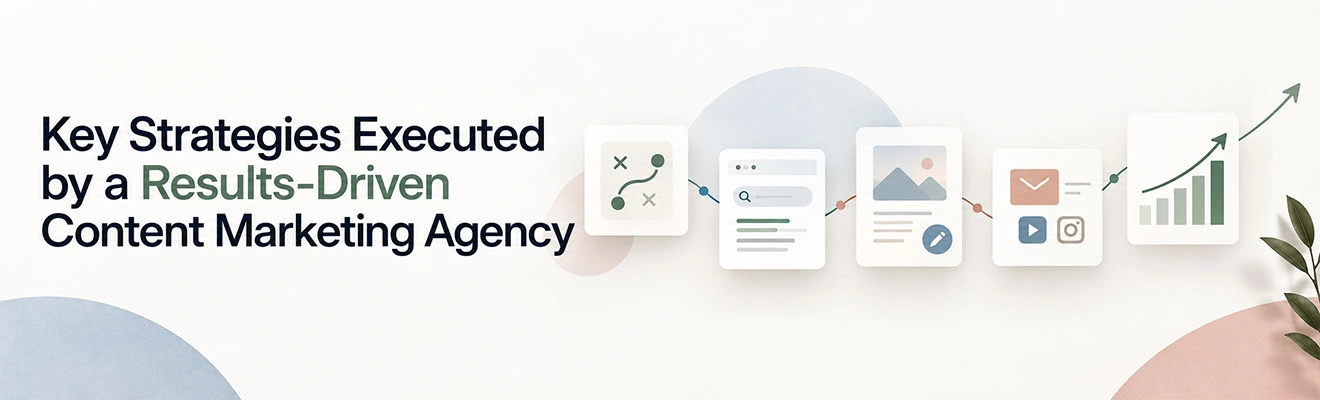
A strong agency builds a connected programme rather than treating every asset as a separate assignment.
| Core solution | Typical deliverables | Business purpose |
| Content strategy | Audience priorities, content audit, editorial roadmap | Direct investment towards relevant opportunities |
| SEO content | Articles, service pages, topic guides | Reach people researching relevant needs |
| Conversion copywriting | Landing pages, email sequences, product copy | Help interested prospects take action |
| Authority content | Case studies, expert interviews, research | Demonstrate expertise and reduce uncertainty |
| Distribution | Newsletters, social content, promotional campaigns | Put useful content in front of suitable audiences |
| Performance analysis | Dashboards, content reviews, improvement plans | Identify what contributes to business goals |
Scope should follow your priorities. A specialist manufacturer may need technical explainers and supplier comparison pages before it needs a high-volume social calendar.
Persuasive content begins with understanding the decision.
What is the customer trying to achieve? What worries them? Which details would make your offer easier to evaluate?
Consider a hostel management software provider. “A comprehensive digital solution” tells a buyer very little. Explaining how wardens monitor attendance, parents receive updates and administrators manage bed allocation gives the service practical meaning.
An agency should gather those details through interviews, sales feedback and product demonstrations. It can then organise the copy around customer needs, support claims with evidence and offer a relevant next step.
Conversion also depends on presentation. Clear navigation, readable layouts, accessible forms and convincing proof help good writing do its job.
A dedicated agency gives your business a repeatable way to communicate. Research, writing, design, approval and reporting become a managed process rather than tasks squeezed between other responsibilities.
That consistency creates room for improvement. Your team can see which questions deserve deeper answers, which pages need stronger evidence and which content attracts suitable prospects.
Recent research underlines the value of strategic refinement. In Content Marketing Institute and MarketingProfs’ 2026 B2B Content and Marketing Trends report, 61% of respondents with a content strategy reported improved effectiveness.74% of those reporting improvement identified strategy refinement as a contributing factor.
The majority of the 1,015 B2B marketers surveyed between June and August 2025 were North American. These are self-reported findings, rather than guaranteed outcomes for individual businesses.
Useful content can continue attracting relevant visitors after publication, particularly when it answers an enduring question and stays current.
An accounting firm, for example, could publish a practical guide to choosing between business structures. Supporting pages could explain compliance responsibilities, documentation and the firm’s advisory service. Together, these assets help readers move from initial research towards a consultation.
Revenue requires that connection. An article should offer a sensible route to a service page, comparison guide, enquiry form or other next step.
However, more traffic does not automatically mean more business. A smaller audience researching a relevant purchase can be more valuable than thousands of visitors seeking unrelated information. Evaluate content by audience fit and contribution to qualified opportunities.
Trust grows when your content makes a difficult decision easier.
That might mean explaining the limits of a service, showing how a project was delivered or answering a pricing question your competitors avoid. Concrete information is provided for customers to review.
For example, a property developer could give updates on the construction and talk about the stages of purchase. For a technology company, it could mean implementation guidance, security information and examples of everyday workflows.
A specialised agency should help surface that knowledge without exaggerating it. Named experts, attributable quotations, verified results and clear explanations make content more credible.
Consistency matters too. If your website promises one thing while your sales presentation suggests another, buyers have to resolve the contradiction themselves.
Effective content programmes balance discovery, consideration and conversion.
Some assets introduce your expertise. Others help buyers compare options. A smaller group supports immediate action. A website filled only with educational articles may leave interested readers unsure how to proceed; a website filled only with sales messages may fail to answer their earlier questions.
An agency should also review what already exists. Updating a useful page, consolidating overlapping articles or improving a weak service page can be more worthwhile than publishing another new post.
Each assignment needs a clear purpose, intended audience and distribution plan before production begins.
Audience research should go beyond broad descriptions such as “business owners aged 30–50”.
Useful research investigates responsibilities, buying triggers, budget concerns, objections, and the language customers use. Sales calls, customer interviews, search data and support enquiries can all contribute.
Keyword mapping then connects those needs to appropriate pages.
| Customer situation | Example search | Suitable content | Relevant next step |
| Understanding a problem | “Why website enquiries are falling” | Diagnostic article | Explore an audit |
| Comparing approaches | “Content marketing vs paid advertising” | Balanced comparison | Discuss channel priorities |
| Evaluating providers | “Content marketing agency for manufacturers” | Industry service page | Review relevant work |
| Preparing to buy | “Content marketing agency pricing” | Scope and pricing guide | Request a proposal |
| Using a service | “How to measure content leads” | Implementation guide | Access support or related services |
The wording of a query is only part of the brief. The writer also needs to understand what would constitute a satisfying answer.
Use keywords naturally in relevant headings and copy. Repeating a phrase cannot compensate for missing information.
Publishing creates an asset. Distribution gives it a chance to reach people.
A detailed customer case study can become a LinkedIn post, newsletter feature, short video and sales presentation slide. Each version should suit the channel while preserving the evidence behind the story.
Choose channels according to audience behaviour. For a B2B consultancy, LinkedIn, email and search might be the focus. A consumer brand may need to do more robust visual storytelling and product demonstrations.
Paid promotion can increase the reach of some assets, particularly when organic distribution is constrained. It requires its own budget and success criteria.
Owned channels are also something to consider. Sales teams can share relevant guides in the middle of conversations, and a valuable newsletter creates opportunities for repeat engagement. Distribution should support how customers actually research and buy.
Start with your business problem before comparing packages.
Are you trying to improve organic discovery, explain a complex service, enter a new market or increase qualified enquiries? Each objective calls for a different emphasis.
Ask potential agencies how they would investigate that problem. Their questions often reveal more than their presentation. A thoughtful partner will want to understand your margins, sales cycle, customer concerns and existing performance.
Review work for clarity and substance. Seek proof that the agency understands your subject matter, your unique customer insight and sound rationales.
Then, the operational arrangement:
Discuss AI use directly. Ask how facts, quotations, originality and brand voice are checked. Editorial accountability should remain clear regardless of the tools involved.
A useful report explains what happened, why it matters and what should change next.
| Metric | What it helps reveal | Important qualification |
| Relevant organic clicks | Whether target topics attract search visitors | Separate branded and non-branded demand |
| Qualified enquiries | Whether content attracts suitable prospects | Agree on lead qualification criteria |
| Conversion rate | Whether visitors complete a useful action | Check tracking and landing-page usability |
| Sales opportunities influenced | Where content supports active deals | Attribution can be incomplete |
| Returning readers and subscribers | Whether audiences want continued contact | Assess audience quality alongside growth |
| Content-assisted revenue | Where content appears in buying journeys | Avoid claiming every influenced sale as content-generated |
Rankings, impressions and engagement can help diagnose performance, but they need context.
CMI’s 2026 research found that 40% of surveyed B2B marketers selected creating content that prompts a desired action among their top three challenges, while 33% selected measuring content effectiveness. These figures explain why conversion planning and measurement deserve attention from the start.
Agree on a baseline before work begins. Connect website analytics with lead records where practical, and ask reporting teams to distinguish observed results from assumptions.
For businesses seeking coordinated support, iDigitalize brings content into a broader digital marketing conversation.
Its published service offering includes content strategy, creation, distribution, promotion and tracking, alongside formats such as blogs, social content and video. The wider service portfolio also includes SEO, copywriting, design, paid advertising and website development. This provides scope for connecting content with the channels and customer experiences surrounding it. iDigitalize
The right starting point is a focused brief: what your business sells, whom it serves and where potential customers lose confidence or interest.
From there, the proposed programme should identify priority pages, evidence to gather, suitable formats and measurable actions. Your team’s expertise is essential. The strongest content comes from real customer questions, operational knowledge and experience that competitors cannot simply reproduce.
Speak with iDigitalize about a content marketing strategy built around your audience, commercial priorities and existing website performance.
1. What does a content marketing agency do?
A content marketing agency researches audiences, develops strategy, creates assets, manages distribution and reviews performance. Its role is to connect useful communication with business objectives such as awareness, customer education, qualified enquiries and retention.
2. How long does content marketing take to show results?
The timing is determined by the quality of the content, distribution, competition and the starting position. Changes to the landing page copy can have a fairly immediate impact on enquiries. Organic discoveries tend to be slower to assess. Rather than counting down to a guarantee deadline, set milestones, and measure progress from your baseline.
3. How much does a content marketing agency cost?
Costs depend on the extent of research, the amount of production, formats, level of specialist expertise and promotional needs. Be sure to provide a detailed Scope of Work that outlines strategy, writing, design, revisions, distribution and reporting. Verify if there are extra advertising costs and external production costs.
4. What is the difference between content marketing and SEO?
Content marketing is the creation and distribution of useful content across a variety of platforms. SEO involves optimising organic search discoverability through website and content improvements. Service pages and researched articles overlap in helping people find relevant information via search engines.
5. Can a content marketing agency generate leads?
When targeted to the right audiences, content can be an effective driver of lead generation, opening the door for relevant next steps. The results also depend on the quality of your offer, the experience of your website and the follow-up on sales. Traffic. Measure qualified enquiries and the opportunities generated from them.
6. How can my business keep agency-written content authentic?
Provide writers with access to verified examples, customer questions, product demos and subject experts. Bring in subject matter experts to review and build a unique brand voice. Authenticity comes from a recognisable point of view and exact detail, supported by careful editing.


